|
The Crystallographic
Restriction |
|
|
|
|
|
|
|
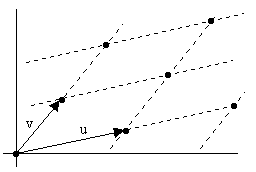
In order for this lattice
to possess rotational symmetry of order k it is necessary for each lattice
point to map to another under rotation through an angle θ = 2π/k.
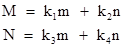
In other words, for every pair of integers m,n, there must be another pair of
integers M,N such that |
|
|
|
|
|
Letting subscripts r and i denote the real and imaginary parts of u and v, we can expand this expression and separate the real and imaginary parts to give the two conditions |
|
|
|
|
|
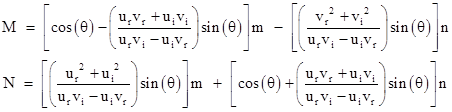
Solving these equations for
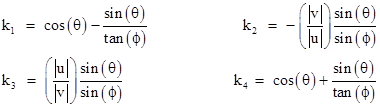
M and N in terms of m and n, we get |
|
|
|
|
|
|
|
|
|
|
|
|
|
|
|
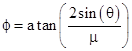
Furthermore, if we let ϕ denote the angle between the basis vectors (i.e., the phase difference between the complex numbers) u and v, then we have the expressions for the scalar and vector products |
|
|
|
|
|
|
|
|
|
|
|
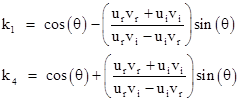
where |
|
|
|
|
|
The determinant k1k4 – k2k3 is identically equal to 1. We also have the relations |
|
|
|
|
|
|
|
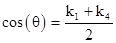
Eliminating ϕ from the first and third, we also have |
|
|
|
|
|
|
|
From this we also get |
|
|
|
|
|
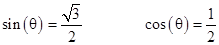
To illustrate, we can set q equal to π/3 = 60 degrees, which is one of the four possible (non-trivial) values. In this case we have |
|
|
|
|
|
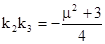
and so k1 + k4 = 1. Now it appears we have some freedom of choice, because we can select integers k2, k3 such that –k2k3 – sin(θ)2 is a square integer μ2, and then compute the values of ϕ, |u|/|v|, and k4 – k1, with which we can infer the individual (integer) values of k1 and k4. For any odd integer μ we can put |
|
|
|
|
|
and then we have |
|
|
|
|
|
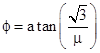
Thus k1 = (1–μ)/2 and k4 = (1+μ)/2. The individual coefficients k2 and k3 can be any factorization of (μ2+3)/4, one positive and one negative. The angle ϕ between the two basis vectors is given (in this example) by |
|
|
|
|
|
The factorization of k2k3 is needed only to determine the ratio of the lengths of the basis vectors using the relation |
|
|
|
|
|
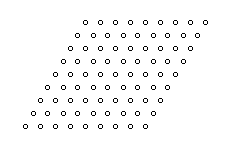
The simplest possibility is to set k2k3 = –1 by putting k2 = –1 and k3 = 1. This corresponds to μ = 1, which gives basis vectors of equal length, and the angle between them is ϕ = 60 degrees. We also get k4 = 1 and k1 = 0, so the lattice transformation is M = –n, N = m + n. This gives the expected triangular lattice with 6-fold rotational symmetry shown below. |
|
|
|
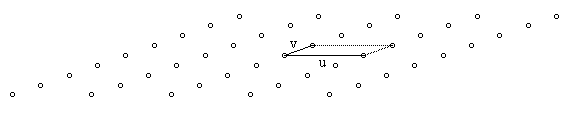
On the other hand, if we take μ = 5 we get k2k3 = –7, and we can select the factorization k2 = –1, k3 = 7. In this case we get k1 = –2, k4 = 3, and |
|
|
|
|
|
|
|
It may seem as if this gives a different lattice from the previous case, but if we plot the lattice points given by these expressions we get the figure shown below. |
|
|
|
|
|
|
|
It is the same lattice as before, merely expressed in terms of different basis vectors. It follows that the "fundamental region" of a lattice is not unique, because the same lattice can be described in terms of different sets of basis vectors, corresponding to different fundamental regions. In order to arrive at a less arbitrary definition, we would stipulate that the basis vectors must be the smallest possible. |
|
|