|
What Was New in Einstein’s EMB Paper? |
|
|
|
Mine is the sunlight, mine is the morning, |
|
Born of the one light Eden saw play. |
|
Praise with elation, praise every morning |
|
God's recreation of the new day. |
|
Eleanor Farjeon |
|
|
|
Occasionally one sees claims that Einstein’s 1905 paper “On the Electrodynamics of Moving Bodies” did not contain anything new, and that it merely repeated the results of Lorentz and Poincare in disguised form. I think such claims are untrue, and are based on misunderstandings of special relativity itself. |
|
|
|
To establish the context, Lorentz’s 1904 paper, entitled “Electromagnetic Phenomena in a System Moving With Any Velocity Less than That of Light”, is focused (as the title suggests) on electromagnetic phenomena, and even says that the mass of an elementary charged particle (an electron) is entirely electromagnetic in origin. Lorentz says “I shall suppose that there is no other, no ‘true’ or ‘material’ mass”. We now know that only a small part of the electron’s mass is due to electromagnetic induction, so Lorentz’s assumption was incorrect, although he later adds the assumption that “the masses of all particles are influenced by a translation to the same degree as the electromagnetic masses of the electrons”. He also introduces the assumption that “the forces between uncharged particles, as well as those between such particles and electrons, are influenced by a translation in quite the same way as the electric forces in an electrostatic system”. In later expositions he clarified that this assumption must even include the so-called inertial forces. Hence, he effectively just assumed that all physical entities and phenomena, including inertia itself, are “influenced by translation” (tacitly relative to the ether frame) in just such a way as to make them Lorentz invariant. |
|
|
|
Poincare published a brief note in 1905, commenting on Lorentz’s paper, correcting the expression for the current density, etc., but in the main agreeing with Lorentz’s results. He remarks that experiments (especially Michelson’s) seem to suggest that the impossibility of detecting absolute motion is a general law of nature. Further, he wrote “I show… assuming that inertia is an electromagnetic phenomenon exclusively, as generally admitted since Kaufmann’s experiments, and apart from the constant pressure that I just mentioned and which acts on the electron, all the forces are of electromagnetic origin”. However, he then goes on to consider how the law of gravitation (which he doesn’t assume is electromagnetic in origin) would need to be modified to ensure complete undetectability of absolute motion. Since he concedes that the gravitational force is not electromagnetic, it is just coincidental (according to his view) if it too is Lorentz invariant. He wrote a much longer paper (commonly called the “Palermo paper”) in the summer of 1905, but it was not published until 1906. In both papers he notes that the (suitably scaled) Lorentz transformations form a group, and in the 1906 Palermo paper he comments that they are formally analogous to a “rotation”, and that along with the actual spatial rotations they form a group such that any incremental interval with components dx, dy, dz, dt leaves invariant the quadratic quantity (dx)2 + (dy)2 + (dz)2 – c2(dt)2. (Klein’s Erlangen program had taught a whole generation to associate invariants and group structure with symmetries, so this was a natural observation.) In the Palermo paper Poincare speculates that perhaps someone may someday overthrow Lorentz’s theory, as Copernicus overthrew Ptolemy’s, by a fundamental change in the terms of description. In later years, although Poincare didn’t discuss Einstein in print, his public lectures attributed to Einstein the “mighty new currents of thought” in the new mechanics represented by what we now call special relativity. |
|
|
|
We should also mention Poincare’s 1904 lecture given in St. Louis, which Einstein could certainly have seen prior to writing his EMB paper. In this public lecture, Poincare surveys each of the great principles of physics (including the classical principle of relativity), and how each of them has been called into question by modern observations. It is basically a compendium of things that were soon to be explained by Einstein, but which Poincare still found perplexing. To give just one example, Poincare addressed the principle of conservation of energy, and noted that |
|
|
|
…after the Curies discovered radium, it was seen that every radioactive substance was an inexhaustible source of radiation… That is already a strain on the principle [of energy conservation]… The explanations advanced were numerous… Sir W. Ramsey has attempted to show that radium is transformed, that it contains an enormous amount of energy, but not an inexhaustible amount… the radium would be exhausted in 1250 years; that is not long, but you see that we are at least sure of being bound to the present state of affairs [i.e., not understanding the source of the energy] for some hundreds of years. While we wait our doubts subsist. |
|
|
|
The main decay process for common radium is 1600 years. Clearly Poincare would not have devoted a lengthy, vague, and bewildered discussion to the ‘mystery’ of seeming violations in the (he thought) separate conservation principles of mass and energy, immediately following his discussion of the principle of relativity, had he known that special relativity itself gives not only a qualitative but also a quantitative account of the equivalence. Compare Poincare’s discussion with Einstein’s the very next year (not hundreds of years later) |
|
|
|
The mass of a body is a measure of its energy content; if the energy changes by E, the mass changes in the same sense by E / (9‧1020), the energy being measured in ergs and the mass in grams. It is not impossible that with bodies whose energy content is variable to a high degree (e.g., with radium salts) the theory may be successfully put to the test. If the theory corresponds to the facts, radiation conveys inertia between the emitting and absorbing bodies. |
|
|
|
If Poincare already understood this in 1904, he certainly missed an opportunity to say it. His 1904 St. Louis address is filled with similar examples, describing what Poincare said were mysterious conundrums, all of which were fully clarified the very next year by Einstein’s paper, showing clearly why these things were much less mysterious than Poincare thought. |
|
|
|
In 1908, Minkowski delivered an address on “Space and Time”, in which, similar to the “Kinematical Part” of Einstein’s 1905 paper, he focuses on spatio-temporal relations, and identifies the same invariant (which serves as a pseudo-metric) as had Poincare. Referring to the transformed coordinate time t′, Minkowski wrote “Lorentz called the t′ combination of x and t the local time of the electron in uniform motion, and applied a physical construction of this concept, for the better understanding of the hypothesis of contraction. But the credit of first recognizing clearly that the time of the one electron is just as good as that of the other, that is to say, that t and t′ are to be treated identically, belongs to A. Einstein”. Interestingly, for this fundamental insight, Minkowski cites not Einstein’s 1905 EMB paper, but his 1907 Jahrbuch survey article. Lorentz too credited Einstein for being the first to recognize the “remarkable reciprocity” between the systems of coordinates related by Lorentz transformations – something that Lorentz himself candidly admitted he had not recognized. We also have an account (Moszkowski) of a public lecture that Poincare gave, in which he evidently attributed the new (and, to Poincare, somewhat dis-tasteful) relativistic “convention” to Einstein. Oddly, Minkowski concluded his 1908 treatise by saying “The validity without exception of the world-postulate, I like to think, is the true nucleus of an electromagnetic image of the world, which, discovered by Lorentz, and further revealed by Einstein, now lies open in the full light of day”. Minkowski’s assistant at the time was Max Born, who later wrote about the impression that Einstein’s 1905 paper had made on him: “Although I was quite familiar with the relativistic idea and the Lorentz transformations, Einstein’s reasoning was a revelation to me…which had a stronger influence on my thinking than any other scientific experience”. |
|
|
|
The new conceptual framework described by Einstein’s 1905 EMB paper are summarized by the following quotes: |
|
|
|
(1) Consider a coordinate system in which the Newtonian mechanical equations are valid. |
|
|
|
This is the first sentence in the first section of Part I of the paper, and it is arguably the most important in the entire paper. In later editions a footnote was added, saying “to the first order of approximation”, because of course one of the conclusions of the paper is that the Newtonian equations of mechanics are valid only in the low speed limit. But this suffices to define the class of coordinate systems, that we may call standard inertial coordinate systems, in terms of which mechanical inertia is homogeneous and isotropic. For example, the systems are determined by the requirement that identical bullets shot from identical mutually resting co-located guns in opposite directions will reach equal distances in equal times. This is inertial simultaneity. Now, there are some problematic aspects to Einstein’s exposition, because at this stage he often speaks of a coordinate system as just consisting of space coordinates, whereas any discussion of Newton’s laws of mechanics obviously involves time. He also never explicitly mentions the inertial definition of simultaneity that his sentence implies. But it is clear enough that the systems of space and time coordinates related by Lorentz transformations to one particular standard inertial coordinate system are nothing but the entire class of standard inertial coordinate systems. Although perhaps not self-evident, this turns out to be equivalent to the proposition that every quantity of energy E, of any form, including kinetic energy, must have inertia m/c2. Einstein noticed this only belatedly, and described it in a follow-up paper “Does the Inertia of a Body Depend on its Energy?” in September 1905. (We’ve discussed elsewhere that special relativity could have been deduced entirely from the principle of energy conservation.) |
|
|
|
It's ironic that the first sentence in the “Kinematic Part” of Einstein’s paper is a statement about dynamics, on which the entire discussion is founded. This has led some critics to contend that Einstein’s approach is dynamics masquerading as kinematics, but I think this is not quite right. Yes, as Newton said, geometry and kinematics are ultimately based on dynamics, because standard inertial coordinate systems are based on dynamics (to define straight paths, isotropy, etc.), but once these systems and the relationships between them have been established, many consequences can be inferred purely from the kinematics. So, it’s justifiable to say that Part I is primarily concerned with kinematics, even while acknowledging that those are based on dynamics, i.e., the inertial behavior of bodies and energy. |
|
|
|
(2) Derivation of Lorentz Transformation with φ(v) = φ(-v) |
|
|
|
In Section 3 Einstein derives the Lorentz transformation with the, as yet, undetermined function φ(v). Lorentz too had derived (actually by means of several assumptions) the transformation with this undetermined function in his 1904 paper, and he carried it along for nearly the entire paper, without determining it. At the end he (Lorentz) finally presented a “not entirely satisfactory” (as he later admitted) argument that this function should have the value 1, but the reasoning was unpersuasive, as Poincare said in his review. Poincare too carried along this “undetermined” function, and never actually gave an argument for setting it to 1, aside from noting that if it equals 1 then the transformations form a group, which is true, but he needs the converse to make the derivation, and the converse is not true. So it can be argued that neither Lorentz nor Poincare actually succeeded in completing the “derivation” of what Poincare named the Lorentz transformation. In contrast, Einstein immediately addressed the function, first establishing that φ(v)φ(-v)=1, and then, since he has shown that it enters into the transformation of the coordinates perpendicular to the direction of motion, resulting in contraction of a rod by this function, he observes that “For reasons of symmetry it is obvious that the length of a rod measured in the system at rest and moving perpendicular to its own axis can depend only on its velocity and not on the direction and sense of its motion. Thus the length of the moving rod measured in the system at rest does not change when v is replaced by -v”. Consequently, φ(v) = φ(-v), and so φ(v) = 1. This completes the derivation of the Lorentz transformation. |
|
|
|
(3) Invariance of null cones. |
|
|
|
The paper notes that the Lorentz transformations preserve null (light-like) intervals, i.e., if (dx)2 + (dy)2 + (dz)2 – c2(dt)2 = 0 then (dx′)2 + (dy′)2 + (dz′)2 – c2(dt′)2 = 0. Of course, this just expresses the invariance of the speed of light in terms of standard inertial coordinates, and it is a special case of the fact that the Lorentz transformation preserves the value of this quadratic expression for all incremental intervals. For purposes of deriving the Lorentz transformations, it suffices that null intervals map to null intervals, so the null cone structure is preserved. |
|
|
|
(4) (1907) “In general, according to the principle of relativity, each correct relation between “primed” (defined with respect to S’) and “unprimed (defined with respect to S) quantities, or between quantities of only one of these kinds, yields again a correct relation if the unprimed symbols are replaced by the corresponding primed symbols, or vice versa, and if v is replaced by -v.” |
|
|
|
The appeared in Einstein’s 1907 survey paper, rather than in the 1905 EMB paper, but since this is the paper that Minkowski cited in his 1908 paper on “Space and Time”, it’s worth mentioning. |
|
|
|
(5) “For superluminal velocities our considerations become meaningless. We shall see in the considerations that follow that in our theory the velocity of light physically plays the part of infinitely great velocities.” |
|
|
|
The identification of light speed with infinite velocity emphasizes that it is not just some pragmatic hurdle but in fact represents an inherent feature of our inertia-based measures of space and time, and their physical meanings. |
|
|
|
(6) “This yields the following peculiar consequence: … the clock that has been transported from A to B will lag… behind the clock that has been [at rest] in B from the outset… this result holds even when the clock moves from A to B along any arbitrary polygonal line, and even when the points A and B coincide.” |
|
|
|
Einstein’s paper was the first to highlight the essential fact, arising from the pseudo-metrical aspect of spatial and temporal relations implicit in the Lorentz transformation between standard inertial coordinate systems, that the elapsed “proper” times between two given events is path-dependent. Nothing shows more powerfully than this the enormity of the advance in Einstein’s paper, and the inadequacy of Poincare’s conventionalism. If Poincare had contemplated time dilation at all, it would have been just as a difference in the conventionally-chosen systems of coordinates, which couldn’t possibly yield actual path dependence. Einstein’s recognition of path-dependent proper time (though he didn’t use that name) is what shows the actual nature of the absolute physical pseudo-metrical relations for paths through space and time, resulting in a completely new understanding of the nature of spatio-temporal relations. It has sometimes been remarked that Einstein’s 1905 paper didn’t explicitly present the expression for the absolute interval, but this description of the clocks is clearly describing the absolute proper time interval along different paths, in physical terms. None of this is to be found in the prior writings of either Lorentz or Poincare. |
|
|
|
(7) The exact expressions for the relativistic Doppler effect and aberration. Also the first published expression of the velocity composition formula. |
|
|
|
Even individuals who have stridently down-played Einstein’s contributions, such as Whittaker, acknowledge that Einstein’s paper was the first appearance of the exact relativistic Doppler and aberration formulas. Regarding the velocity composition formula, Poincare is said to have written it in a private letter to Lorentz prior to the appearance of Einstein’s paper, but that is not a formal publication. |
|
|
|
(8) “It is noteworthy that the energy and the frequency of a light complex vary with the observer’s state of motion according to the same law.” |
|
|
|
This is a crucial fact, connecting special relativity with Einstein’s previous paper on light quanta and the photo-electric effect, in which the relation E = hν plays a central role, i.e., the energy is strictly proportional to frequency. |
|
|
|
(9) “It should be noted that these results concerning mass are also valid for ponderable material points, since a ponderable material point can be made into an electron (in our sense) by adding to it an arbitrarily small electric charge. |
|
|
|
This emphasizes that the inertia of a body depends not on its electric charge (via electromagnetic induction, as had been thought by Lorentz and Poincare) but on its energy content, so it applies even to neutral ponderable matter. Considerations like this are what prompted Einstein to later say that what was essentially new in his 1905 EMB paper was the recognition that the Lorentz transformation transcended its connection with Maxwell’s equations, and was a consequence of the fundamental (inertial) measures of space and time. Indeed, it should also be noted that Einstein’s previous paper had shown that Maxwell’s equations couldn’t even claim fundamental validity, since they did not account for the micro-phenomena of electromagnetic radiation. This is why he entirely avoided (unlike Lorentz and Poincare) basing special relativity on Maxwell’s equations. |
|
|
|
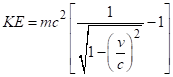
(10) The kinetic energy KE of a ponderable (rest) mass m is |
|
|
|
|
|
|
|
Here we find perhaps the most fundamental result in the paper, clarifying that special relativity entails (indeed, it almost consists of) the recognition that the kinetic energy of any material entity (not just an electric charge) of mass m and velocity v (in terms of a given standard system of inertial coordinates) is not (1/2)mv2, but actually increases to infinity as v approaches c. It also clearly suggests that the rest energy of the mass m is mc2. Einstein’s follow-up paper in September highlighted the conclusion that “The mass of a body is a measure of its energy content; if the energy changes by E, the mass changes by E/c2”. |
|
|
|
Neither Lorentz nor Poincare (let alone anyone else) ever gave anything approaching the comprehensive treatment of Lorentz invariant special relativity (as distinct from Galilean relativity) found in Einstein’s 1905 papers. Some people consider the absence of the explicit pseudo-metrical formalism and the related geometrical analogy in Einstein’s papers to be a significant shortcoming, but the mathematical formalism adds nothing to the physical content of special relativity. We do not say that Newtonian mechanics should be attributed to Lagrange because Newton failed to express it in Lagrangian terms. |
|
|
|
Young people are often mightily impressed by the poetic enthusiasm of Minkowski’s “Space and Time”, grandly announcing that henceforth space by itself and time by itself are doomed to fade away, etc., but adult physicists understand that the content of special relativity is nothing but (local) Lorentz invariance, as described very thoroughly in Einstein’s papers. One item that was not contained in Einstein’s papers was the observation, found in the writings of both Poincare and Minkowski, that if we assign imaginary units to the time coordinate, the pseudo-metric looks superficially like the Euclidean metric. Indeed, Minkowski was particularly impressed by this, referring to the assertion “3*105 km = √-1 sec” as the “mystic formula” that makes the quadratic line element perfectly symmetrical in the space and (scaled) time coordinates. However, this was never an operational part of special relativity, and practitioners invariably just use the actual pseudo-metric with suitable signature (1, -1, -1, -1) and inner product. Time is not just another space dimension, and it has not proved useful to pretend that it is. |
|
|
|
More generally, some critics have lamented that Einstein’s 1905 paper was not expressed in more overtly “geometrical” terms. Philosophers have debated whether “geometry” is efficacious or merely descriptive, but as Newton said, “geometry is properly part of mechanics; geometry does not teach us how to draw straight lines, but requires them to be drawn”. The physical basis of special relativity is dynamical inertia, not abstract mathematical pseudo-metrics. The latter can be used to describe the former, but they cannot be regarded as explanatory. The benefit of Minkowski’s formalism (elaborating on the hints from Poincare) is that it facilitates writing down the laws of physics in a form that makes their local Lorentz invariance self-evident. This, of course, was later exploited by Einstein in his consideration of curved manifolds using tensor analysis to write the field equations of general relativity in generally covariant form, such that they automatically transform locally in a Lorentz invariant way. |
|
|
|
Another point of confusion concerns the concept of a “four dimensional” space-time manifold. Some people would like to regard this as an important aspect of special relativity, but Einstein always denied – rightly – that relativity introduced this four-dimensionality to physics. He pointed out that the phenomena of physics have always been treated in a four-dimensional setting, three of space and one of time, even in Newtonian mechanics. It’s true that early physicists tended to treat the spatial degrees of freedom with coordinates while treating the temporal degree of freedom as a parameter. Obviously this was easier to do with the split Newtonian metric, whereas the tilting of the temporal foliation in special relativity makes it more convenient to treat the temporal degree of freedom as another coordinate rather than a parameter, but this again is just a matter of convention and convenience. |
|
|
|
In general, questions of priority for a given discovery depend on what precisely we regard as the discovered thing. As an analogy, consider the question of who discovered calculus. Some aspects of calculus, such as crude integrations of Archimedes, were known for over a thousand years prior to Newton and Leibniz, and the concept of differentiation can be found in the writings of Fermat and others. Also, calculus continued to be developed, in important ways, in the centuries after Newton and Leibniz. Despite all this, it’s common to attribute the discovery of calculus to Newton and/or Leibniz. The litmus test for whether or not someone is in possession of “the calculus” seems to be what’s called the Fundamental Theorem of Calculus, which is the proposition that differentiation and integration are reciprocal operations. Indeed the anagram that Newton sent to Leibniz (by way of Oldenberg) to stake out his claim (without revealing it) was “Given an equation involving any number of fluent quantities to find the fluxions, and vice versa.” If someone recognizes this reciprocity, we say they know calculus, whereas if they don’t recognize it we say they don’t know calculus. This is admittedly a somewhat arbitrary boundary, and this reciprocity is fairly evident, especially after it’s been pointed out, but the explicit recognition of it, and the conscious exploitation of it, was arguably the crucial step in the discovery of calculus. |
|
|
|
Similarly, with regard to special relativity, one could argue that the recognition of the reciprocity between relatively moving systems of standard inertial coordinate systems, related to each other by Lorentz transformations, was the crucial insight that distinguishes between knowing special relativity and not knowing it. Of course, Poincare was aware that the Lorentz transformations form a group (as both he and Einstein noted in their 1905 papers), and he knew that Maxwell’s equations were valid in a class of coordinate systems related by those transformations, but he clearly did not recognize that those were the standard inertial coordinate systems, in terms of which mechanical inertia is isotropic (i.e., in terms of which the equations of Newtonian mechanics hold good in the low speed limit). All of Einstein’s contemporaries credited Einstein (not always approvingly) with this Copernican re-orientation, restoring inertia as the organizing principle. |
|
|
|
As Max Born later wrote (“Physics in the Last Fifty Years”) about his days in Gottingen as Minkowski’s assistant, “We studied the recent papers of Lorentz and Poincare, we discussed the contraction hypothesis brought forward by Lorentz and Fitzgerald, and we knew the transformations now known under Lorentz’s name. Minkowski was already working on his four-dimensional representation of space and time, published in 1907… yet Einstein’s simple consideration by which he disclosed the epistemological root of the problem made an enormous impression, and I think it right that the principle of relativity is connected with his name, though Lorentz and Poincare should not be forgotten”. On the other hand, Born’s focus on the principle of relativity (which dates back to Galileo) and his appraisal of the “root of the problem” as being epistemological in nature (“the impossibility of defining absolute simultaneity because of the finite velocity of light signals”) shows that he didn’t recognize the significance of inertial simultaneity. To this day there continues to be misunderstanding of what is conventional (e.g., the choice to use standard inertial coordinates, which can be defined without recourse to light signals at all), and what is empirical (e.g., the speed of light is unambiguously c in terms of every system of standard inertial coordinates) in the descriptions of special relativity. So, one could say the process of “discovering special relativity” continues. |
|
|