|
Area of a Triangle with Inscribed Circle |
|
|
|
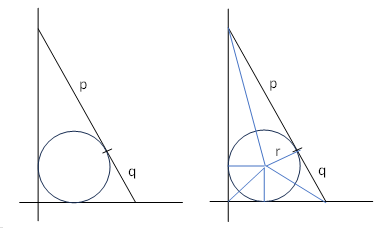
Consider a circle inscribed in a right triangle as shown on the left below. |
|
|
|
|
|
|
|
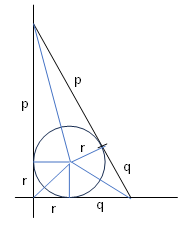
Given the values of the lengths p and q, what is the area of the triangle? In the drawing on the right we have included lines emanating from the center of the circle perpendicularly to the edges, and so to the vertices. By symmetry, lines from an exterior point to the tangents of a circle have equal lengths and are bisected by the line from the point to the center of the circle, so we immediately have the lengths shown below. |
|
|
|
|
|
|
|
Now, we can write down the area of the main triangle in two different ways, one by piecing together the six constituent triangle areas, and one by directly computing the large triangle area, as follows. |
|
|
|
|
|
|
|
Expanding the right hand expression and substituting from the left hand expression, we see that these two expressions for A are both satisfied only if A = (1/2)(pq+A), and hence A = pq. |
|
|
|
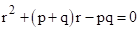
The key to this solution is that these two expressions are not algebraically redundant. The right hand expression would give the area of the triangle even with a circle of a different radius, but the left hand expression is the area of the triangle only if the circle is tangent to the edges as shown. To compute the radius of the circle, we can equate these expressions for A and simplify, resulting in the condition |
|
|
|
|
|
|
|
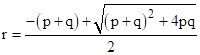
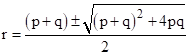
We would get this same condition by applying Pythagoras’ theorem (p+r)2 + (q+r)2 = (p+q)2. Solving for r gives the radius of the inscribed circle |
|
|
|
|
|
|
|
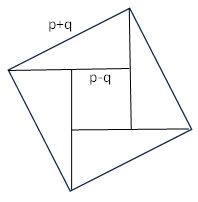
Substituting this into either expression for A confirms that A = pq. Yet another approach to determining the area, given only that the right triangle edges have lengths p+r, q+r, and p+q is to note that the difference between the long and short legs of the triangle is (p+r)-(q+r) = p-q, so we can arrange four copies of the triangle in a square as shown below. |
|
|
|
|
|
|
|
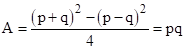
From this we see (again) that the area of the triangle is |
|
|
|
|
|
|
|
These alternative approaches show that we can determine the area of the triangle purely from the premise that the hypotenuse is p+q and the other two edges are p+r and q+r for some constant r. The interesting fact is that these conditions imply that a circle of radius r inscribed in the triangle touches the hypotenuse at the point that splits it into segments p and q. |
|
|
|
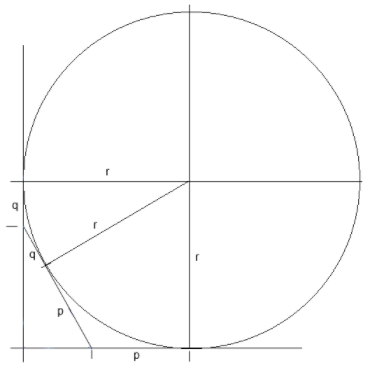
In the preceding discussion we took just the positive root for the radius r, but one might wonder if the negative root has a geometrical significance. The magnitude of that alternate root represents the radius of the circle tangent to the three extended edges as shown in the figure below. |
|
|
|
|
|
|
|
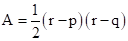
Here we’ve shown exactly the same triangle as previously, although the tangent point to the hypotenuse splits the edge on opposite sides, so q is the upper segment and p is the lower. As before, we make the assignments of lengths to the symmetrical tangents to the circle, and then we have the area |
|
|
|
|
|
|
|
And by Pythagoras’ theorem we have |
|
|
|
|
|
|
|
Combining these two relations leads again to the area A = pq for the triangle. Also, solving the Pythagorean relation for r gives the two roots |
|
|
|
|
|
|
|
Which are just the negatives of the two roots for the interior configuration. |
|
|
|
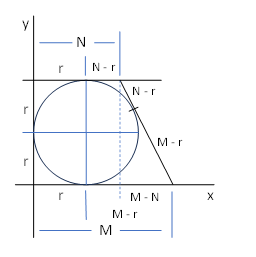
We can also consider the closely related problem of finding the radius of a circle inscribed in a right trapezoid as shown below. |
|
|
|
|
|
|
|
Focusing on the right triangle with hypotenuse consisting of segments of length N-r and M-r, the base if M-N and the other edge if 2r, so by Pythagoras’ theorem we have |
|
|
|
|
|
|
|
Solving this for r gives the well-known result |
|
|
|
|
|
|
|
In other words, the diameter D=2r is the harmonic mean |
|
|
|
|
|
|
|
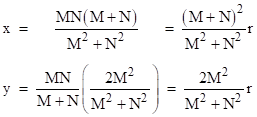
We can also determine the coordinates of the point of tangency on the hypotenuse |
|
|
|
|
|
|
|
As expected, at M=N we have x=2r, y=r. This also has the correct asymptotic behavior, i.e., as M increases to infinity the coordinates of the tangent point approach x=r, y=2r, and as M approaches r and N approaches infinity the coordinates approach x=r, y=0. |
|
|
|
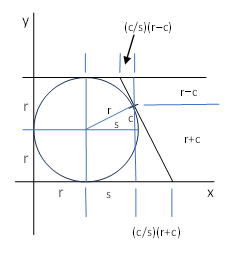
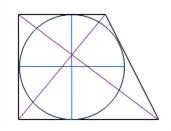
The fact that the diameter of the circle is the harmonic mean of the parallel trapezoid sides is such a simple relation that it’s tempting to think there should be some more immediate rationale for it. Another derivation can be inferred from the drawing below. |
|
|
|
|
|
The lengths of the parallel trapezoid sides can be read directly from the figure, and the sum of the reciprocals of those lengths is |
|
|
|
|
|
|
|
where we’ve made use of the fact that s2 + c2 = r2. It’s also easy to see that the diagonals of the trapezoid intersect at a point that is half the harmonic mean of the parallel edge lengths, so those diagonals necessarily intersect on the vertical diameter of the circle. |
|
|
|
|
|
|