|
Pythagoras’ Spheres |
|
|
|
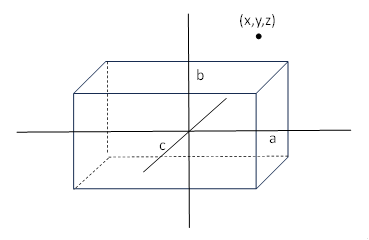
Consider a 3-dimensional rectangular solid, centered at the origin of Cartesian coordinates, with vertices at (±a, ±b, ±c) as illustrated below. |
|
|
|
|
|
|
|
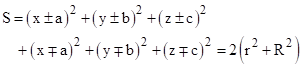
The sum S of the squared distances from an arbitrary point at (x,y,z), which may be inside or outside the solid, to any two diagonal vertices is given by an expression of the form (with suitable signs) |
|
|
|
|
|
|
|
where r2 = x2 + y2 + z2 and R2 = a2 + b2 + c2. The signs in the first squared distance can be chosen arbitrarily, and the signs in the second squared distance are the opposites, representing the coordinates of diagonal vertices. This shows that, not only does the sum of squared distances from any given point to any pair of diagonal vertices have the same value, but the locus of points having any given value of S is a sphere concentric with the solid. The same applies in any number of dimensions. For example, a rectangular solid in 5-dimensional space has 32 vertices, consisting of 16 diagonal pairs, and for any given point the sum of squared distances from that point to any two diagonal vertices is the same. Also, the locus of points with any given sum is a 5-dimensional sphere, concentric with the solid. |
|
|
|
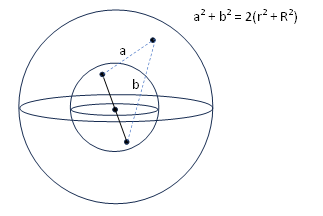
The proposition can be seen as a dual relationship between two concentric spheres, of radius r and R. The sum of squared distances from any point on either sphere and any two diametrically opposed points on the other sphere is 2(r2 + R2), as shown below. |
|
|
|
|
|
|
|
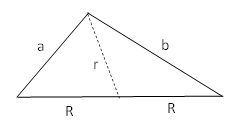
This is essentially just a useful generalization of Pythagoras’ Theorem, as depicted in the figure below. |
|
|
|
|
|
|
|
By the reasoning described above, we have a2 + b2 = 2(r2 + R2), and of course for a right triangle we have r = R, meaning the locus of vertices is the circle of diameter 2R on the base, and we have the usual Pythagorean Theorem a2 + b2 = (2R)2. The general relation applies to any triangle, parameterized by the distance from a vertex to the midpoint of the opposite edge. |
|
|
|
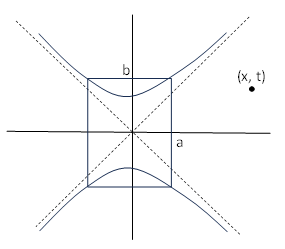
A similar proposition applies to the pseudo-metrical relations between concentric hyperbolas, as can be inferred from the figure below. |
|
|
|
|
|
|
|
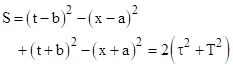
The sum of squared invariant pseudo-metrical intervals between the event at x,t and two diametrically opposed vertices of the rectangle is |
|
|
|
|
|
|
|
where τ2 = t2 – x2 and T2 = b2 – a2. In this pseudo-metrical context the squared intervals can be negative. Again we have a dual relationship, in this case between hyperbolas, according to which the sum of squared intervals from any event on one hyperbola to any two “diametrically” opposed events on the other has the value 2(τ2 + T2). |
|
|