|
Slices of a Triangle |
|
|
|
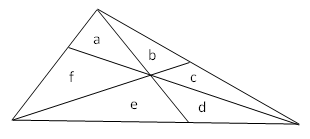
We discussed in another article the relations between six triangular regions comprising an arbitrary triangle, but here we consider the same topic from a slightly different perspective. As before, suppose an arbitrary triangle is partitioned into six triangular regions by three lines through its vertices that intersect at a point, as shown in the example below. |
|
|
|
|
|
|
|
The letters “a” through “f” denote the areas of the respective regions. Making use of the area, base, and altitude relations for pairs of triangles with bases on the same edges, we immediately have the relations |
|
|
|
|
|
|
|
and these simplify to |
|
|
|
|
|
|
|
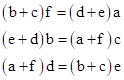
As noted in the previous article, we can multiply these together to give the interesting relation |
|
|
|
|
|
|
|
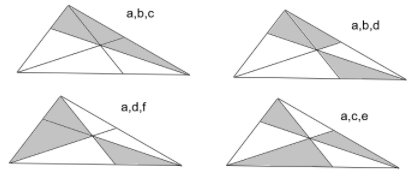
Given any three of the areas, we can solve these three equations for the remaining three, but the complexity of the solution depends on which three areas are given. The four basic cases are as shown below. |
|
|
|
|
|
|
|
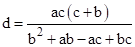
Once four of the areas are known, the remaining two can be found by two linear equations in those two unknowns, so we only need to find one area from the given three areas. The simplest case is if three consecutive areas are given, such as a,b,c. In that case, we can trivially solve for area “d” to give |
|
|
|
|
|
|
|
from which the remaining edges can easily be computed. |
|
|
|
Slightly more challenging is the case when a,b,d are given. From the governing relations we can infer that area c is the positive root of the quadratic |
|
|
|
|
|
|
|
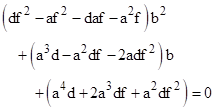
The next most difficult case is when a,d,f are the given areas. In this case, we can compute the area b as the root of the quadratic |
|
|
|
|
|
|
|
Incidentally, the discriminant of this quadratic is |
|
|
|
|
|
|
|
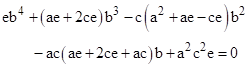
The last and most complicated case is when a,c,e are the given areas. In this case, area b can be found as the root of the quartic |
|
|
|
|
|
|
|
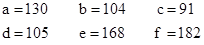
An example with six integer areas is given by |
|
|
|
|
|
|
|
As mentioned above, if any four areas are known, the remaining two can be directly computed, although the formulas differ depending on which two areas are to be computed. If the unknowns are a,f we can compute |
|
|
|
|
|
|
|
If a,e are the areas to be computed, we have |
|
|
|
|
|
|
|
Lastly, if a,d are to be computed, we have |
|
|
|
|
|
|