|
The Fourth Area |
|
|
|
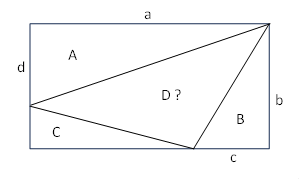
Here is an interesting puzzle involving a triangle inscribed in a rectangle as shown below. |
|
|
|
|
|
|
|
The symbols A, B, C, D denote the areas of the respective triangular regions, and the symbols a, b, c, d denote the lengths of the respective line segments. Given just the areas A, B, C of the outer triangles, the puzzle is to determine the value of the fourth area D. |
|
|
|
The three exterior right triangles are each half of a rectangle (cut diagonally), and those rectangles fill up the overall rectangle, with two of them overlapping in one rectangular corner. Therefore, the sum S = A+B+C of the areas of the three exterior triangles is simply half the sum of the overall rectangle and the overlapped rectangle, so we have S = (ab+cd)/2 and hence D = ab – S = (ab–cd)/2. Consequently we have S2 – D2 = abcd, and since ad = 2A and bc = 2B, we have the result D2 = (A+B+C)2 – 4AB. |
|
|
|
As an example, if we have A=14, B=6, and C=5, we get the result D = 17. These areas would be given with segment lengths a = 7√2, b = 3√2, c = 2√2, and d = 2√2. |
|
|
|
Constructing examples with integer areas is not too difficult. The governing equations can be written in the form |
|
|
|
|
|
|
|
This can be satisfied in many ways, since the two factors on the right just need to have the product 4AB. For example, we may set |
|
|
|
|
|
|
|
In this case, for any choices of A and B we have |
|
|
|
|
|
|
|
Thus if we set A=14 and B=6 we get C=5 and D=17, as in the example we considered above. |
|
|