|
What is a Trigonometric Proof? |
|
|
|
Don’t let us get sick, don’t let us get old, |
|
Don’t let us get stupid, alright? |
|
Just make us be brave, and make us play nice, |
|
And let us be together tonight. |
|
Warren Zevon |
|
|
|
Trigonometry consists of a notation for expressing certain geometrical ratios in terms of special functions of the related angles. A set of identities involving these functions are then established. When treated as an axiomatic system for plane trigonometry, the basic axioms involving these special functions include sin(x) = -sin(-x) and sin(x)2 + cos(x)2 = 1, the latter being essentially the Pythagorean Theorem. |
|
|
|
In 1927 Elisha Loomis published a book entitled The Pythagorean Proposition, in which he gave an exhaustive presentation of various proofs of the Pythagorean Theorem. He remarked that there could be no trigonometric proof, because trigonometry is essentially founded on (among other things) the Pythagorean proposition, so any such “proof” would be circular. As he put it: |
|
|
|
There are no trigonometric proofs, because all the fundamental formulae of trigonometry are themselves based upon the truth of the Pythagorean Theorem; because of this theorem we say sln(A)2 + cos(A)2 = 1, etc. Trigonometry is because the Pythagorean Theorem is. |
|
|
|
There is no special kind of “trigonometric reasoning”. It is simply algebra applied to plane geometry in convenient notation, making use of some standard special functions, in terms of which many useful identities can be conveniently expressed. Of course, a typical proof of the Pythagorean Theorem involving geometrical ratios can obviously make use of the trigonometric names for those ratios, but this doesn’t constitute a “trigonometric proof”. Loomis is not saying a proof cannot mention any trigonometric functions, he is merely saying that all non-trivial aspects of trigonometry rely on the Pythagorean theorem, so any purported trigonometric proof is either circular or else is merely a formal usage of functions that doesn’t add any non-trivial content to the proof. |
|
|
|
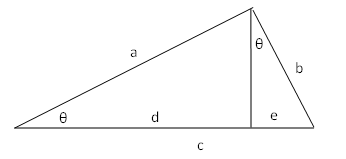
For a trivial example, consider the right triangle shown below. |
|
|
|
|
|
|
|
We know that the angles marked with θ are indeed equal by similar triangles, and we have e/b = sin(θ) and d/a = cos(θ), and also b/c = sin(θ) and a/c = cos (θ). Thus we have e/b = b/c and d/a = a/c, and hence a2 = cd and b2 = ce, yielding the result a2 + b2 = c(d+e) = c2. |
|
|
|
In this proof we expressed certain ratios by their trigonometric names as functions of the free angle θ, but this clearly adds nothing to the proof. We could just as well omit any mention of those functions, and simply assert the equalities of the corresponding ratios by similar triangles. Other more elaborate demonstrations can be given, involving things like the double-angle formula, etc., but these are all just algebraic relations involving the ratios of lengths. More or less by definition, a “trigonometric proof” is one that makes use of some non-trivial trigonometric identities, among the most basic of which is the Pythagorean proposition itself. |
|
|