|
More on Dual Parallelepipeds |
|
|
|
I’d help you make this hutch, but these |
|
Instructions are in Japanese, |
|
So I’ll say oyasumi, Lady Jane. |
|
|
|
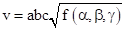
As discussed in another note, the volume v of a parallelepiped with three edge vectors a,b,c emanating from a single vertex can be written as |
|
|
|
|
|
where |
|
|
|
|
|
and α,β,γ denote the angles between the pairs of edges b,c and c,a and a,b respectively. Next we consider the dual parallelepiped, defined as having the three emanating edge vectors |
|
|
|
|
|
|
|
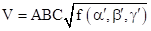
Again the volume V of this solid is given by |
|
|
|
|
|
|
|
where α′, β′, γ′ are the angles between the pairs of the three edges A,B,C. Using the expression for the magnitude of the cross product, this can be written as |
|
|
|
|
|
|
|
where |
|
|
|
|
|
In another article we discussed the interesting fact that V = v2. Making use of that relation we have |
|
|
|
|
|
|
|
By symmetry, since the angular relations are mutual, we also have |
|
|
|
|
|
|
|
For clarity, we will let s and f denote the functions of the un-primed angles, and S and F denote the functions of the primed angles, so we can write these two relations as |
|
|
|
|
|
|
|
Solving the first for F and substituting into the second, we get |
|
|
|
|
|
|
|
from which we get |
|
|
|
|
|
|
|
and therefore |
|
|
|
|
|
|
|
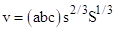
This leads to the “quarky” expression for the volume of a parallelepiped |
|
|
|
|
|
|
|
It’s interesting that the relations (1) imply s2S2 = fF, so it follows that if we define |
|
|
|
|
|
|
|
we have the “uncertainty relation” |
|
|
|
|
|
|
|
This is similar to how two distributions that are Fourier transforms of each other have variances whose product equals 1. In quantum mechanics the position and momentum are, in a sense, Fourier transforms of each other, and the product of the variances of those distributions is 1. The analogy here is that the dual sets of angles are similar to the dual distributions, and the g function is analogous to the variance of those distributions. |
|
|
|
In the preceding discussion we glossed over the fact that if the original vectors have dimensions of length then the transformed vectors have units of length squared, and the so-called volume has units of length to the 6th power. We could address this superficially by dividing the cross products by a fixed unit scalar with dimensions of length, but a more illuminating approach is to normalize the edge transformation by dividing by the cube root of the volume. In other words, given the original three edge vectors a,b,c we define the transformed vectors as |
|
|
|
|
|
|
|
where (as before) v denotes the volume (a x b) ‧ c. These vectors now naturally have the correct units of length, so we can speak correctly of the transformed parallelepiped, and it’s easily verified that the volume (A x B) ‧ C of this transformed solid is also v (i.e., the same as the original solid), and that the transformation is reciprocal, i.e., we have |
|
|
|
|
|
|
|
Admittedly the calculation of the transformed volume makes use of the fact that the numerator is v2, but it’s interesting that the reciprocal transformation yields equal volumes, which seems more intuitive. In this context we have |
|
|
|
|
|
|
|
where we’ve made use of the cross product magnitudes such as A = bc sin(α)/v1/3, and so on. (We know the volume (a x b) ‧ c can be written as the product of the edge lengths and a function of the angles, because we can write each edge vector as a product of the magnitude and a unit vector, and we can then factor out the magnitudes, leaving just a function of the unit vectors which is independent of the edge lengths.) Squaring the first relation for v, and clearing the fraction in the third, we get |
|
|
|
|
|
|
|
Equating these two, we get the same relations between the transformed angles as we had before, i.e., we have F = (f/s)2 and by symmetry f = (F/S)2, from which we get (as shown previously) the expression for the volume |
|
|
|
|
|
|
|
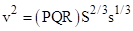
Now we can more easily see why the un-normalized transformation gives the transformed “volume” as the square of the original volume, because if we define P,Q,R as the simple cross-products P = b x c, etc., without normalization, we have ABC = (PQR)/v, and hence |
|
|
|
|
|
|
|
From this perspective, the second factor of v is just the effect of the scale factors applied to the reciprocal transformation that gives equal volumes. It’s also interesting that this approach didn’t specify the angular functions f and F, other than stipulating that the volume equals the product of the edge magnitudes and some function of the angles. The s and S functions (i.e., the products of sines) simply emerge from the trigonometric expressions for the magnitude of the cross product. |
|
|
|
The prior expressions for the volume v can be factored as |
|
|
|
|
|
|
|
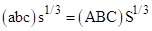
Therefore we have the relation between the edges and angles of the dual solids |
|
|
|
|
|
|
|
In the special case when one solid has a = b = c = L1 and α = β = γ = θ1 and the other (dual) solid has A = B = C = L2 and α’ = β’ = γ’ = θ2, we have L13 sin(θ1) = L23 sin(θ2), which is reminiscent of Descartes’ law of refraction. |
|
|