|
Radius of Circle with Inscribed Polygon |
|
|
|
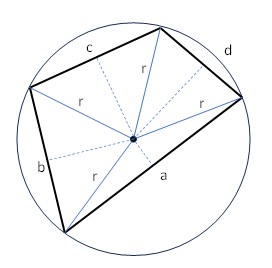
Consider the cyclic quadrilateral shown below. |
|
|
|
We can immediately write down an equation in the radius r, by just equation the sum of the areas of the four central triangles with bases a,b,c,d and their respective “heights” to the area A of the quadrilateral as follows |
|
|
|
|
|
|
|
The area of the quadrilateral is given by Brahmagupta’s famous generalization of Heron’s formula, so we have A = (1/4)Q where |
|
|
|
|
|
|
|
However, clearing the radical leads to a very high-degree polynomial in r2 that then must be factored. We would prefer an explicit expression for r, and indeed we have Parameshvara’s expression |
|
|
|
|
|
|
|
To prove this, consider just the first term in the above equation for the total area |
|
|
|
|
|
|
|
The quantity under the square root sign is actually a square, i.e., we have |
|
|
|
|
|
|
|
Substituting into the previous equation, we have |
|
|
|
|
|
|
|
The other three terms have similar expressions, and multiplying through by 4Q gives the final result |
|
|
|
|
|
|
|
This confirms that we do indeed have r = q/Q, which written out in full is |
|
|
|
|
|
|
|
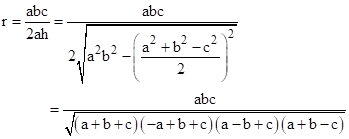
In the special case where one of the edge lengths, say d, equals zero, the inscribed polygon is just a triangle, and the expression for the radius reduces to |
|
|
|
|
|
|
|
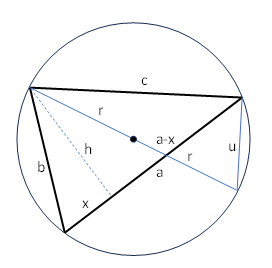
The case of a triangle has a simple geometrical proof. |
|
|
|
|
|
|
|
Using the Pythagorean relations |
|
|
|
|
|
|
|
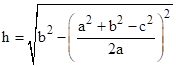
we can subtract one from the other to give x=(a2+b2-c2)/(2a), from which we get |
|
|
|
|
|
|
|
Also, by similar triangles (since they subtend the same chord c from points on the circle) we have b/h = 2r/c, and therefore |
|
|
|
|
|
|
|
Reportedly the formulas for the radius of a circle circumscribing a quadrilateral were found in the 15th century by the Indian mathematician Vatasseri Parameshvara (c. 1380–1460). It would be interesting to know if there is a simple geometrical proof for the quadrilateral case as there is for the triangle case, or if he approached the problem algebraically. |
|
|