|
Two Circles and a Tangency |
|
|
|
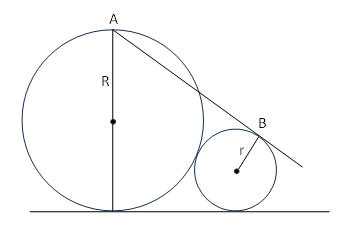
Given the radii R and r of the two circles shown below, what is the length of the line segment AB? |
|
|
|
|
|
|
|
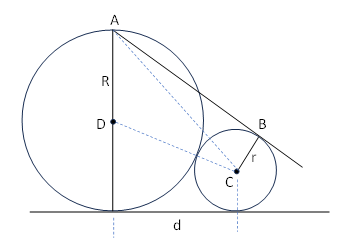
To answer this question, we will let “d” denote the horizontal distance between the centers C and D of the circles, and we will draw the line segments AC and DC, as shown below. |
|
|
|
|
|
|
|
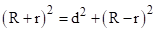
We know the length of CD is R+r, and the squared length is |
|
|
|
|
|
|
|
from which we get d2 = 4Rr. Also, the squared length of the segment AC is d2 + (2R−r)2, and therefore by Pythagoras’ Theorem the squared length of AB is |
|
|
|
|
|
|
|
and hence the length of the segment AB is 2R. |
|
|
|
Given that this result is independent of r, it follows that as r varies, the point of tangency always lies on a circle of radius 2R centered on point A, even for cases when r exceeds R. |
|
|
|
Incidentally, this question is sometimes posed on test or job interviews by specifying just the value of R, without any mention of r. At first sight it may appear to be under-specified, although by employing the “test taker’s logic”, assuming the question is not ill-posed and has a unique answer, we might reason that the answer must be independent of r. On this basis, we could immediately see the answer, either by considering the case when r goes to zero, so that B goes to the bottom of the large circle, and hence the length of AB is obviously 2R, or by considering the case when r = R, so we have two identical circles side by side, and again the length of segment AB is obviously 2R. Whether this is a legitimate “solution” is debatable, since this “test taker’s” reasoning doesn’t actually prove that the result is independent of r, but the meta-reasoning will probably be appreciated by the job interviewer. |
|
|
|
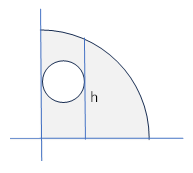
There are many simple math questions of this type, for which an apparently missing piece of information is actually not needed because the answer is independent of that parameter. For example, we might be asked to determine the shaded area of the circle quadrant in the figure below. |
|
|
|
|
|
Letting x denote the diameter of the small circle, and R the radius of the circular quadrant, we have the Pythagorean relation h2 + x2 = R2, and the shaded area is (1/4)πR2 – π(x/2)2, which equals (π/4)(R2 – x2). Therefore, making use of the Pythagorean relation, the area is (π/4)h2, independent of the diameter of the small circle. Using the “test takers” logic, we could have surmised this independence, and just considered the case as the small circle’s diameter goes to zero, in which case h is the radius of the quadrant circle, which immediately gives the result (π/4)h2 from the full quadrant’s area. |
|
|