|
Under-Specified But Unique |
|
|
|
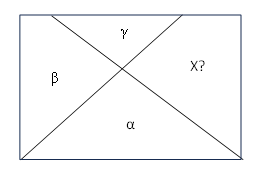
Consider a rectangle with two intersecting lines in the interior as shown below. |
|
|
|
|
|
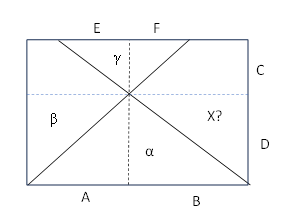
The symbols α, β, γ denote the given areas of the respective regions, and we are asked to determine the remaining area X. This is an example of a problem in which the given information is insufficient to determine the figure, but there is nevertheless a unique answer to the question. To see this, let’s draw vertical and horizontal lines through the central crossing point, and mark the segment lengths as shown below. |
|
|
|
|
|
|
|
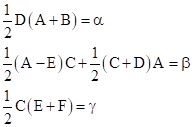
By similar triangles we have E = (C/D)B and F = (C/D)A, and the given areas lead to the relations |
|
|
|
|
|
|
|
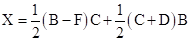
We also have the expression for X |
|
|
|
|
|
|
|
Lastly, the overall area of the rectangle is |
|
|
|
|
|
|
|
The equations for a and γ give |
|
|
|
|
|
|
|
Solving the right hand equation for C and substituting from the left hand equation for D, we get |
|
|
|
|
|
|
|
Substituting for C and D into the equation for the overall area of the rectangle gives |
|
|
|
|
|
|
|
This answers the original question, but it doesn’t determine the values of A,B,C,D. Substituting for C, D, and E in the equation for b, we get the condition |
|
|
|
|
|
|
|
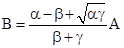
Solving for B, this gives |
|
|
|
|
|
|
|
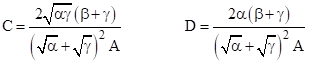
Thus for any value of A we get a figure that satisfies the conditions of the problem if we use this value of B along with the values of C and D given by |
|
|
|
|
|
|
|
The corresponding values of E and F are |
|
|
|
|
|
|
|
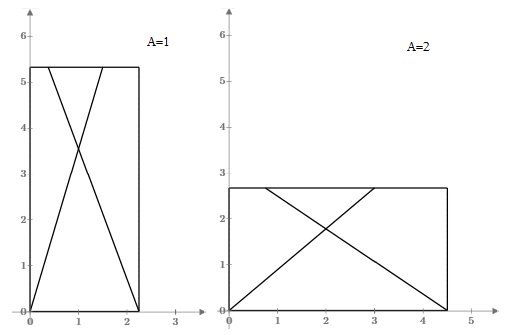
This shows that there is a one-parameter family of solutions, one for every value of A, and each of which has the same four areas. Two examples, for A=1 and A=2, are shown below. |
|
|
|
|
|
|