|
The Minkowskey Contraction |
|
|
|
One minute I held the key |
|
Next the walls were closed on me. |
|
Coldplay |
|
|
|
Suppose we have an ordered set of (say) 12 entities, and we want to present these entities in an un-ordered way, with labels that encode their ordering but don’t reveal it without a decoding key. One possible approach would be to assign a 4-digit decimal number d3d2d1d0 to each entity, such that these numbers map to the ranking R represented by the natural numbers 1 to 12, but in a non-obvious way. For example, we could just let the ranking be a fixed linear combination of the digits, i.e., |
|
|
|
|
|
|
|
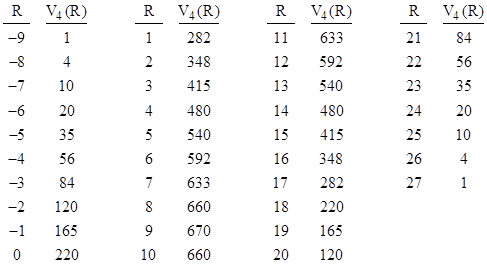
where the constant coefficients A,B,C,D constitute the “key”. To illustrate, we might use the Minkowski “spacetime signature” by setting [A,B,C,D] = [-1,1,1,1]. This “works” because the mapping from 4-digit numbers to the 12 ranks is many-to-one, meaning that many of the 4-digit numbers map to each of the rankings, and the ranges of these sets overlap, so we have significant freedom to choose 4-digit numbers whose ordering is more or less independent of the rankings. Using the Minkowskey, the number V4(R) of 4-digit numbers that map to each possible ranking R from -9 to 27 are shown below. |
|
|
|
|
|
|
|
These valencies are symmetrical about R=9, and they add up to 10000 as required (covering the 4-digit numbers from 0000 to 9999). These are the same valencies as the sums of digits of 4-digit numbers, merely shifted due to negating the lowest digit, so the range goes from -9 to 27 instead of from 0 to 36. This is clear from the fact that we can do a digit-wise sum of each number from 0000 to 9999 onto the base 0,0,0,0, and we can do the same thing onto the base 0,0,0,-9, or the base 0,-9,0,-9, and so on. Each of these yields essentially the same set of sums of digits, but offset by a multiple of 9. |
|
|
|
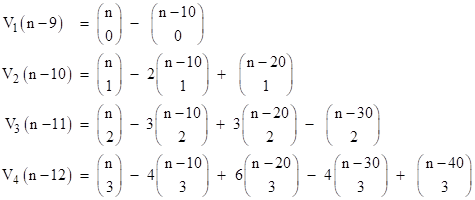
We also note that the valencies are just the binomial coefficients C(3,k) until reaching 282, at which point they begin to diverge by quantities that are 4 times the numbers 1, 4, 10, 20, 35, 56, 84, 120, 165, 220. At this point they begin to diverge by 10 times the numbers same sequence of numbers, and so on. The sequence of multipliers are also the binomial coefficients C(n,3). A similar pattern emerges for the Minkowskey contractions of k-digit decimal numbers (i.e., contractions with coefficients [−1,1,1..]. Thus, if we define b(n) = C(3+n,3) and we denote the generic sequence of valencies vj with justified indices, we have the relation |
|
|
|
|
|
|
|
with the understanding that vn = 0 for all n < 0. Since the valencies equal the binomial coefficients for the first ten values, one might wonder if the coefficients on the right side are really the binomial coefficients or the valencies (self-referentially!), but it can be verified that they are indeed the binomial coefficients. |
|
|
|
Making successive substitutions and simplifying for the cases of 1 to 4-digit numbers, it can be shown that the valencies are given in terms of binomial coefficients by |
|
|
|
|
|
|
|
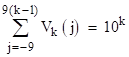
and so on. For example, the number of non-negative 4-digit decimal numbers that yield the rank R=1 is given by setting n=13 in the above equation for V4(n−12), which gives C(13,3) – 4C(3,3) = 282, in agreement with the preceding table. For k-digit decimal numbers, these expressions give non-zero ranks only for the range from −9 to 9(k−1). For all other ranks they are identically zero. We also have the identity |
|
|
|
|
|
|
|
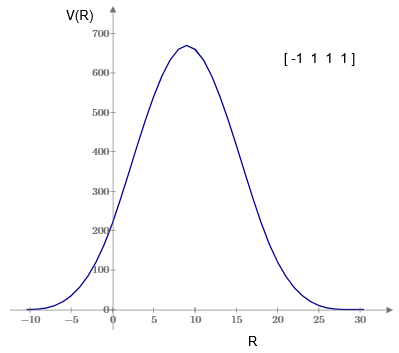
The plot below shows that distribution of the number of representations for each value of R for the signature [-1 1 1 1]. As we saw in the table, the peak of 670 occurs at R=9, and the distribution is symmetrical about that value. |
|
|
|
|
|
|
|
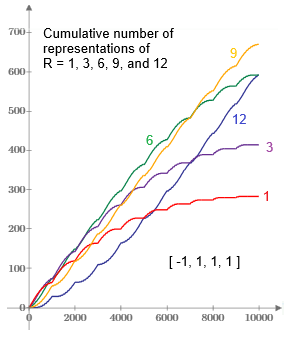
It’s also interesting to see how the possible representation are distributed over the range from 0000 to 9999. The plot below shows the cumulative number of representations for R = 1, 3, 6, 9, and 12 over this range. |
|
|
|
|
|
|
|
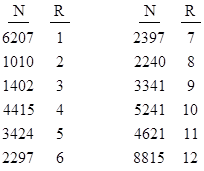
One set of 4-digit numbers N that map to the rankings 1 to 12 under the Minkowskey contraction [-1,1,1,1] is shown below. |
|
|
|
|
|
|
|
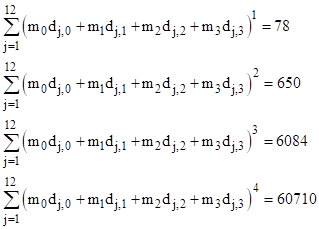
The digit-wise sums of corresponding digits of the twelve numbers are 41, 40, 37, 40. If we were given just the twelve values of N (unordered) that map to the integers 1 to 12 under a linear transformation of the digits, how difficult would it be to infer the mapping and hence the ordering? One deterministic approach would be to consider the four conditions on the four unknown key coefficients mk shown below. |
|
|
|
|
|
|
|
where the right hand numbers are the sums of the nth powers of the integers 1 to 12, and dj,k is the kth digit of the jth number. We could solve the first (linear) equation for m0 and substitute for that into the remaining three equations. Then we could solve the second (quadratic) equation for m1 and substitute for that into the remaining two equations. Then we could solve the third (cubic) equation for m2 and substitute for that into the last equation. Finally, we could solve the fourth (quartic) equation for m3. Since this involves nothing more than quartics, it could in principle be carried out with nothing more than arithmetic and root extractions. However, in practice, the number of terms in these polynomials would be enormous, so it would likely not be practical. |
|
|
|
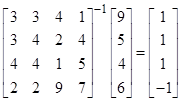
Another approach would be to simply try each of the 24 permutations of the 495 4-element subjects of the 12 ranks, set equal to the first four numbers, and simply solve that set of four linear equations for the coefficients, checking for a case in which the coefficients are all integers (assuming the key has integer coefficients). For example, if we take the 4-digit numbers 4621, 3341, 1402, and 2297, we will eventually match them with the ranks 9, 5, 4, 6 respectively, with which we get purely integer coefficients |
|
|
|
|
|
|
|
As expected, this gives the Minkowskey coefficients. Granted, this could take up to 11,880 trials, but it’s straight-forward and easily performed on a computer. So we really only need the first four numbers to find the key, aside from some potential false positives that happen to give integer coefficients by chance. These could be checked with the next number. Incidentally, knowing the determinant of the left hand matrix, we can evaluate the divisibility conditions that must be satisfied by the numerator to give integer coefficients. |
|
|
|
So far we have focused on contractions with the spacetime signature, but more generally, we can consider arbitrary contraction keys. We may prefer keys that have co-prime coefficients, because obviously the only achievable ranks are multiples of the LCM of the coefficients. To illustrate, consider the contraction given by |
|
|
|
|
|
|
|
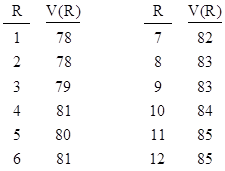
Clearly the representations are spread out over a larger range, and each rank R in the range of (say) 1 to 12 has fewer representations, and the distribution is less smooth than for the Minkowskey cases. The numbers of representations for the ranks 1 to 12 with this key are |
|
|
|
|
|
|
|
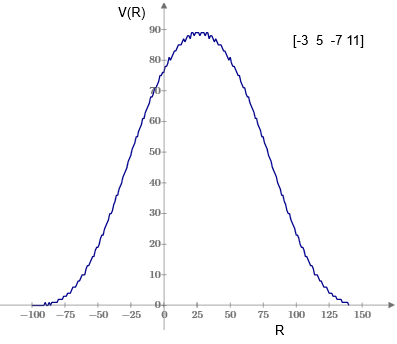
A plot of the distribution of the number of representations over the entire range of representable ranks with this key is shown below. |
|
|
|
|
|
|
|
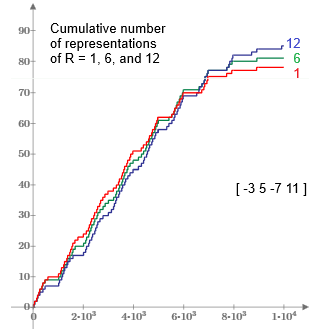
We can see how the representations for a given R value are distributed over the range from 0000 to 9999 by plotting the cumulative number of representations. The plot below shows this for R = 1, 6, and 12. |
|
|
|
|
|
|
|
The fact that the curves flatten out at the high end signifies that there are fewer representations of these ranks at the upper end of the range of 4-digit numbers. |
|
|
|
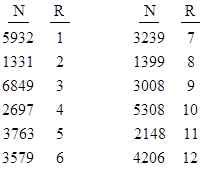
One set of 4-digit numbers N that map to the ranks 1 to 12 under this [-3,5,-7,11] key is shown below. |
|
|
|
|
|
|
|
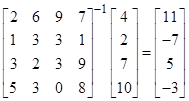
We could again apply the purely algebraic approach, or more straight-forwardly if we are given four of the numbers, say 2697, 1331, 3239, 5398, we could check the 11,880 possible rankings for these four numbers, and eventually arrive at 4, 2, 7, 10, which gives |
|
|
|
|
|
|
|
This overall contraction method relies on at least one coefficient being negative. A different approach would be to choose a key [A,B,C,D] and then simply evaluate [(Ad0 + Bd1 +Cd2 + Dd3) modulo 12] + 1 to give the rankings from 1 to 12. This would concentrate all the mappings into the desired range. |
|
|