|
At Least One Boy |
|
|
|
Did I request thee, Maker, from my Clay |
|
To mold me Man, did I solicit thee |
|
From darkness to promote me, or here place |
|
In this delicious Garden? As my Will |
|
Concurred not to my being, it were but right |
|
And equal to reduce me to my dust, |
|
Desirous to resign, and render back |
|
All I received, unable to perform |
|
Thy terms too hard, by which I was to hold |
|
The good I sought not. |
|
John Milton |
|
|
|
Assuming each child born is equally likely to be a boy or a girl, and we randomly select a parent from among all those who have two children, the probability that this parent has at least one girl is 3/4, because three of the four equally-likely outcomes BB, BG, GB, GG include at least one girl. |
|
|
|
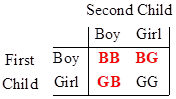
On the other hand, if we randomly select a parent from among all parents who have two children, at least one of which is a boy, then the three equally likely outcomes are BB, BG, GB, two of which have a girl, so the probability that the selected parent has a girl is 2/3. This well-known result (see the related note) can be represented by the entries highlighted in red in the table below. |
|
|
|
|
|
|
|
Of course, if we randomly select a parent from among all parents who have two children, the older of which is a boy, then the possible families are BB and BG, so the probability that the younger child is a girl is 1/2. Likewise, if we randomly select a parent from among all parents whose have two children, the younger of which is a boy, then the possible families are BB and GB, so the probability that the older child is a girl is 1/2. |
|
|
|
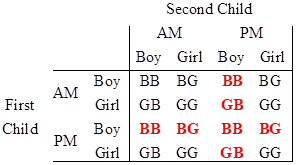
To make things slightly more interesting, suppose we randomly select a parent from among all parents who have two children, at least one of which is a boy born in the PM. In this case the possible families are shown in red bold font in the table below. |
|
|
|
|
|
|
|
Thus there are seven possible (and, by stipulation, equally probable) outcomes, in four of which the “other” child is a girl, so the probability that the “other” child is a girl is 4/7. Notice that if we had randomly selected parents of two children whose first child was a boy born in the PM, then the probability of the second child being a girl is 1/2. Similarly if the boy is stipulated to be the second child. In each of these cases, there are four possibilities, two of which have a girl. We get a different result when we stipulate at least one boy born in the PM, without specifying first or second, because those two sets intersect in the outcome BB, so there are a total of just 7 possible outcomes, including all four of the outcomes with a girl. |
|
|
|
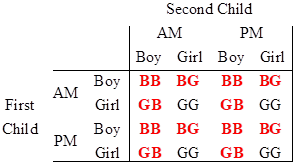
Of course, if we stipulate that we randomly select a parent from those who have at least one boy, born in either the AM or the PM, then there are 12 possible outcomes, as shown in the red bold font in the table below. |
|
|
|
|
|
|
|
The number of qualifying sets is 12 rather than 14 because the 7 AM-Boy column and row intersect with the 7 PM-Boy column and row in two more locations (all the BB states), and these 12 states include all 8 of the states with a girl, so the probability of the “other” child being a girl is 8/12 = 2/3, consistent with the earlier result for which any time of day qualified. |
|
|
|
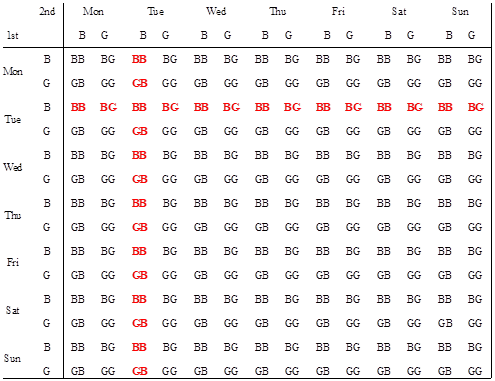
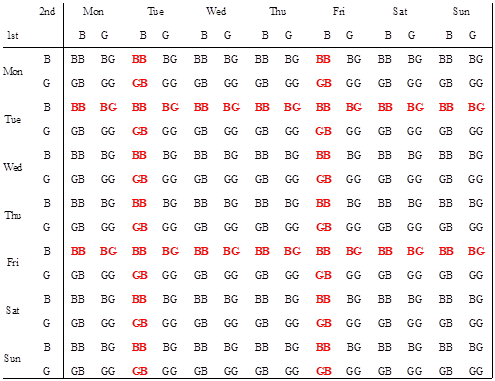
For another example, suppose we randomly select a parent from the set of all parents who have at least one boy who was born on a Tuesday. The possible combinations are shown in red in the table below. |
|
|
|
|
|
|
|
The total number of possibilities is 27 = 14 + 14 – 1, because the two sets overlap in a BB combination, but all 14 of the combinations involving a girl are distinct, so the probability that the “other” child is a girl is 14/27 = 0.518…, which is slightly greater than 1/2, but much less than 2/3. |
|
|
|
Of course, if we replaced Tuesday with any other specific day of the week, we would get the same answer. This sometimes strikes people as paradoxical, since every boy was obviously born on some particular day of the week, but recall that we are randomly selecting parents with at least one boy born on one specific day of the week, which is different than selecting parents with a boy born on any day of the week. |
|
|
|
To help clarify this, suppose we select a parent randomly from all the parents with two children, at least one of whom is a boy born on either Tuesday or Friday. The set of possibilities are shown in red in the table below. |
|
|
|
|
|
|
|
To the original 27 possibilities we add 25 = 27 – 2 more, because there are two overlaps between the Friday possibilities and the Tuesday possibilities. The overlaps are always BB states, so the number of possibilities with a girl is 28 = 14 + 14. Thus, the probability of the “other” child being a girl in this case is 28/52 = 0.538... We get the same result for any two days of the week. |
|
|
|
Similarly, for a parent randomly selected from the set of parents with two children, at least one of which is a boy born on any of three specified days of the week (say, Tuesday, Friday, or Saturday), the total number of possibilities is 75 = 27 + 25 + 23, because the third day has two overlaps with each of the two other days, and the number of those with a girl is 3(14) = 42, so the probability that the “other” child is a girl is 42/75 = 0.560... Notice that the total number of overlaps is always a square number, as can be seen immediately from the intersecting red rows and columns in the table. |
|
|
|
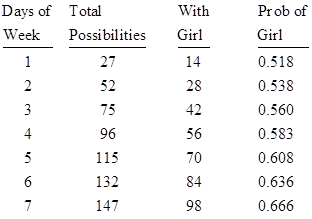
Proceeding in the same way, we can determine the probability given that we are randomly selecting a parent from all parents with at least one boy born on any 4, 5, 6, or 7 specified days of the week. The results for all the cases are summarized in the table below. |
|
|
|
|
|
|
|
As required, the probability of a girl for the case when the parent has at least one boy born on any of the seven days is the same as the probability for the simple case when the day is not specified at all. |
|
|
|
In general, if we split up the state space into k parts (such as k=2 for AM and PM, or k=7 for the days of the week, or k=24 for the hour of the day, etc.), and we consider specifying at least one boy in one of j of those k categories (so if we specify Tuesdays and Fridays, we have j=2), then the total number of possibilities is 4kj – j2 = (4k−j)j, and the number of those with a girl is 2kj. Consequently, the probability that the “other” child is a girl is |
|
|
|
|
|
|
|
The basic puzzle has k=j=1, which gives probability 2/3. The AM/PM puzzle has k=2, j=1, giving a probability of 4/7. The standard “day of the week” puzzle has k=7, j=1, which gives a probability of 14/27. As required, whenever j=k we have the probability 2/3. |
|
|
|
Questions of this kind are often posed by just stating that a man has two children, at least one of which is a boy, and we’re asked the probability that the other child is a girl. However, this is ambiguous, because it doesn’t specify the context (overall state space) and distribution. This is why we’ve stated the questions in terms of randomly selecting a parent from the subset of all parents, consisting of parents with exactly two children, at least one of which is a boy born on a Tuesday (for example). This is the kind of specification necessary for a well-posed question. The disadvantage of stating the context clearly is that it makes the answers fairly obvious, whereas the puzzler’s objective is often to baffle the listener. |
|
|