|
Rotated Reverse Digit Multiples |
|
|
|
Sophocles once said we must not rate |
|
A man’s life good until he’s passed away |
|
And lies beyond the fearsome whims of fate. |
|
|
|
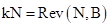
Letting Rev(N,B) denote the digit reversal of N in the base B, we can generate solutions of |
|
|
|
|
|
|
|
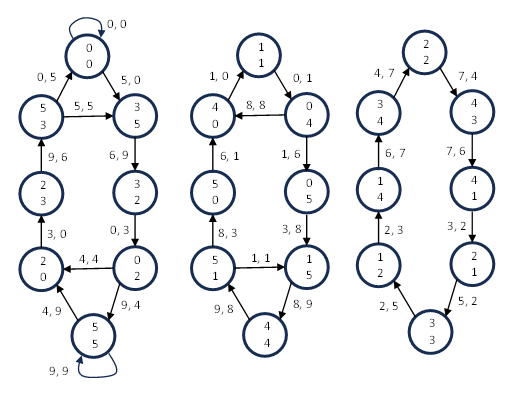
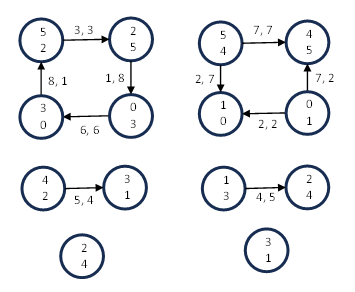
for a given integer k by means of graphs (sometimes called Young graphs) as described in previous notes here, here, and here. To illustrate, consider the case B=10, k=6. The carries must range from 0 to 5, so there are k2 = 36 carry states, and 24 of these states are related by the graphs shown below. |
|
|
|
|
|
|
|
The digit pairs around any closed loop in such a graph deals to sets of digits whose ratios are related to k. The simplest case occurs when we start a closed loop at the carry state [0,0]. For example, beginning from state [0,0] in the left hand graph above, we can proceed around the outer loop to give the sequence of digit pairs |
|
|
|
|
|
|
|
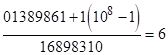
The left hand digits form the “numerator” and the right hand digits form the “denominator” (which are the same digits in reverse order), giving the result |
|
|
|
|
|
|
|
Alternatively, we could take the “short cut” by cutting directly across from [0,2] to [2,0], to give the sequence of digit pairs |
|
|
|
|
|
|
|
which represents the ratio |
|
|
|
|
|
|
|
Some authors describe the process as proceeding from the [0,0] state to either a repeated carry state [a,a] or to a pair of transposed states [a,b], [b.a], and then “backtracking” with the opposite digits to form a single number, but this corresponds to simply going around the loop to form both numbers. This is because of the duality that if [a,b]—(r,s)→[c,d] is a valid graph segment then so is the dual [b,a]←(s,r)—[d,c]. Many, though not all, graphs are self-dual, including the ones containing the [0,0] state. We saw in a previous note that the case B=22,k=7 contains two large and distinct dual graphs. |
|
|
|
We can obviously expand these solutions by looping arbitrarily many times on the 9 and 0 digits, and we can also “stack” the results by circling the loops multiples times, etc. |
|
|
|
If we consider the central graph above, the digit pairs going around the outer loop, beginning from state [1,1], are |
|
|
|
|
|
|
|
The two digit-reversed numbers given by these pairs are related to the ratio k, but we need to augment the numerator by u(Bn – 1) where n is the number of digits (8 in this case) and u is the lower index of the origin state (1 in this case). Thus we have |
|
|
|
|
|
|
|
which can also be written as |
|
|
|
|
|
|
|
If we rotate the digits of the two reversed numbers, it is the same as starting the loop from a different state. The same relation applies to all these rotated expressions, except that the coefficient on the right hand side is always the lower index of the source state. Thus, for all of these rotated versions, the “numerator” number is congruent to 6 times the “denominator” number, modulo 108 – 1. |
|
|
|
For another example, the right-most graph shown above, beginning from the state [2,2], gives the loop of decimal digit pairs |
|
|
|
|
|
|
|
Since the lower index of the initial carry state is 2, we have the relation involving k and the two digit-reversed numbers |
|
|
|
|
|
|
|
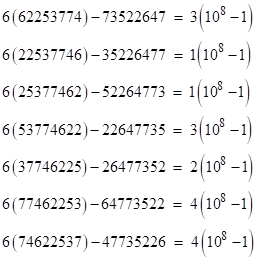
We could equally well have chosen any of the states as the initial state, and the effect would be to rotate the digits of the two numbers, with the lower index from the initial state as the coefficient of the right hand side in each case. Thus we have all of the identities |
|
|
|
|
|
|
|
Since we are rotating the digits in the same directions, these numbers are not “in phase” reversals, but they are reversals when viewed as cycles of digits, disregarding the mutual phases. |
|
|
|
The space of 36 carry states for B=10, k=6 has 12 additional states, whose properties are shown by the graphs below. |
|
|
|
|
|
|
|
The only loop among these is the graph on the upper left, which starting from the state [3,0] gives the sequence of decimal digit pairs |
|
|
|
|
|
|
|
This gives the relation |
|
|
|
|
|
The numerator and denominator are cyclical reversals, though not aligned. Typically a loop like this one ends with a repeated digit pair, aside from which the other digits are aligned reversals. |
|
|
|
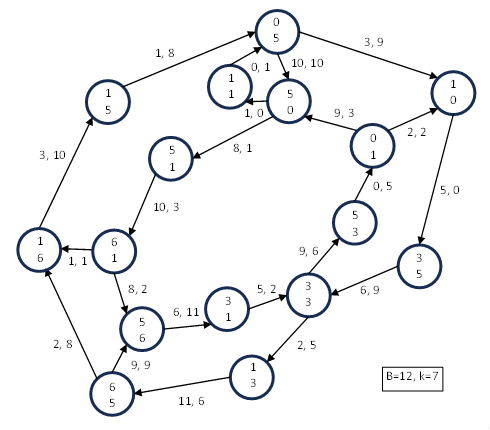
For another example, consider the case B=12, k=7, which has no loops extending to the state [0,0], but it has the interesting self-dual graph shown below. |
|
|
|
|
|
|
|
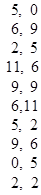
The duality consists of the fact that if we transpose each pair of carry state indices, and each pair of transition digits, and reverse the direction of each transition arrow, we get the same topological graph, merely with the outer and inner rings exchanged pictorially. One loop contained in this graph begins with carry state [5,0], and yields the base-12 digit pairs |
|
|
|
|
|
|
|
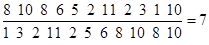
Thus we have |
|
|
|
|
|
As noted previously, aside from the repeated digit pair at the end, the numerator and denominator are digit reversals of each other, and if we view the numbers cyclically, they are fully reversals, just out of phase by one digit. To see this, rotate the denominator by one digit to the right, so the 10 moves to the front. |
|
|
|
A similar example is given by starting with the state [1,0] and proceeding around the loop with the transition digit pairs |
|
|
|
|
|
|
|
Therefore we have |
|
|
|
|
|
Again the repeated digit pair 2,2 effectively rotates the digits by one, but the numerator and denominator are cyclically reversals of each other, as seen by rotating the denominator one digit to the right. |
|
|
|
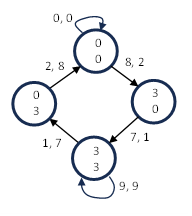
A popular puzzle asks for solutions in the case B=10, k=4, which leads to the usual null-anchored graph |
|
|
|
|
|
|
|
This is a self-dual graph. Beginning from the state [0,0] and circling the loop, we get the sequence of digit pairs (8,2), (7,1), (1,7) and (2,8), so we have the familiar primitive solution |
|
|
|
|
|
|
|
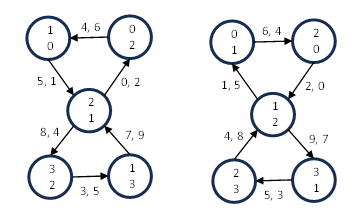
More solutions are given by circling the loop more times, and/or circling the self-loops with digits 9 and 0. However, the carry state space also includes the two other non-trivial graphs shown below. |
|
|
|
|
|
|
|
Since neither of these are self-dual (they are duals of each other), they don’t give rotated reverse digit solution, but they give infinite solutions as discussed in a previous note, by circling the loops infinitely many times, as exemplified by the relations for the left hand graph |
|
|
|
|
|
|
|
In these expressions the ellipses indicate the string of digits is repeated indefinitely. Of course, by the geometric series, they are also exact ratios for each individual cycle. Likewise for the right hand graph we have the infinite solutions |
|
|
|
|
|
|
|
In the article on infinite solutions, the example for B=22,k=7 involved a graph that was also not self-dual, which is why it didn’t give rotated reverse digit solutions, it just gave infinite solutions. But the examples given above, based on the cases B=10,k=6 and B=12,k=7, have non-null graphs that are self-dual, so the loops give finite reverse digit solutions, although generally rotated. |
|
|
|
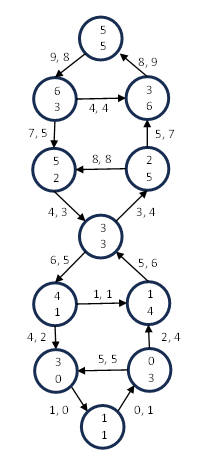
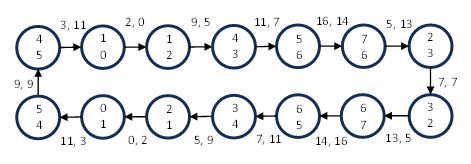
Another illuminating example is the case B=10, k=7. The null carry state just transitions to itself, but there is nevertheless a very interesting graph for this case as shown below. |
|
|
|
|
|
|
|
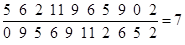
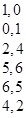
Starting from the carry state [3,0] and proceeding maximally around the entire loop (not taking the available shortcut at 8,8 or any of the available detours/subloops), we have the sequence of digit pairs |
|
|
|
|
|
|
|
These digits give the exact ratio of rotated reverse digit numbers |
|
|
|
|
|
|
|
If we rotate the denominator by two digits to the left, we put the reversed digits in phase with the numerator. Similarly if we take the shortcut and turn around at state [3,3] we get the sequence of digit pairs |
|
|
|
|
|
|
|
we have the exact ratio of rotated reverse digit numbers |
|
|
|
|
|
|
|
If instead we begin with the state [1,1] and proceed around the entire outer loop, we get the sequence of digit pairs |
|
|
|
|
|
|
|
This makes the 12-digit numerator N and denominator D perfect in-phase digit reversals of each other, but since the lower index of the initial state is 1, we have |
|
|
|
|
|
|
|
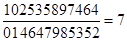
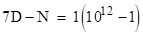
The bottom triangular sub-loop starting from [3,0] gives 105/015 =7, and from [1,1] it gives 7D-N = 1(103 – 1), and from [0,3] it gives 7D-N = 3(103-1). |
|
|
|
For one last example, consider the case B=17, k=8, whose state space includes the graph shown below. |
|
|
|
|
|
|
|
Starting from the state [1, 0] the digit pairs around the loop give the ratio of integers in base 17 |
|
|
|
|
|
|
|
The denominator digits are the reversal of the numerator digits, but rotated by three digits. This makes it clear why we cannot get in-phase reversals unless we begin from the [0,0] state, because to get in-phase reversal requires that the initial state be at a symmetrical point in the loop, receiving from [a,b] and sending to [b,a], but by duality this can only occur if the initial state has repeated indices [c,c], and as we’ve seen, we have kD − N = c(Bn – 1) where n is the number of digits, so we need c to be zero, and hence the starting state must be [0,0] for in-phase reversal. But if we allow for the digits to be rotated, we have a greatly enlarged set of solutions, as shown above. |
|
|